
Dogecoin (DOGE)
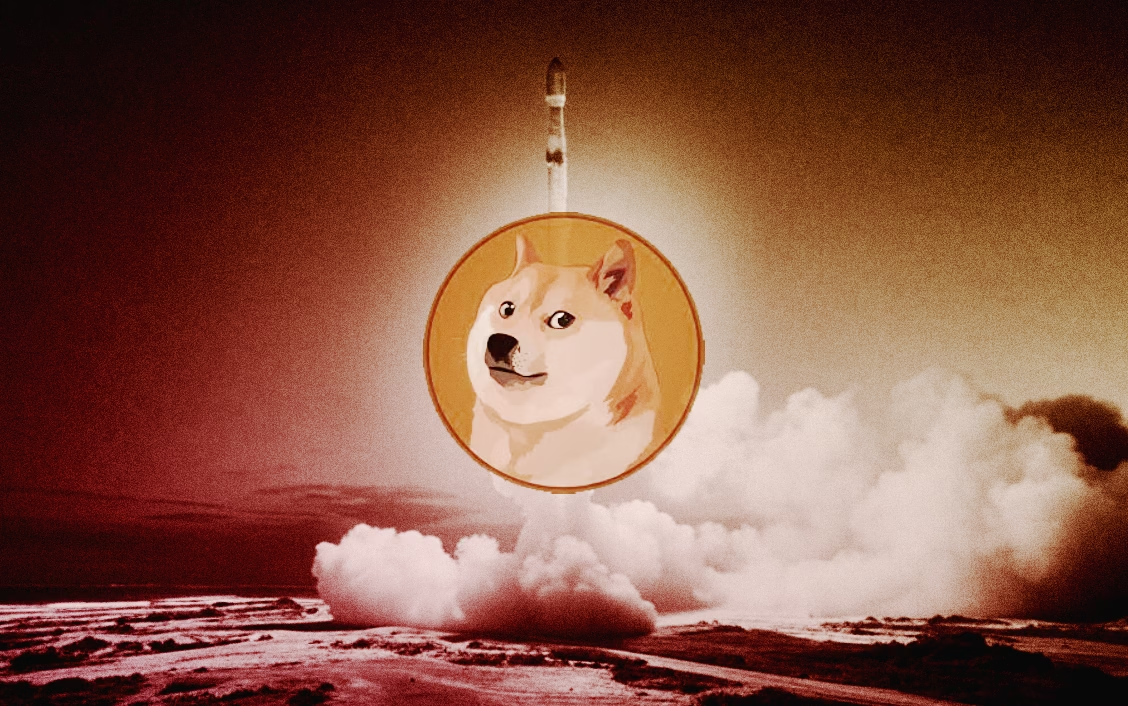
Dogecoin (currency symbol: DOGE) is a peer-to-peer, open-source cryptocurrency created in December 2013 as a lighthearted parody of the cryptocurrency boom then underway, based on the "Doge" internet meme depicting a Shiba Inu dog accompanied by fragmented, broken-English captions. Despite its origins as a joke, Dogecoin has endured for more than a decade to become one of the most widely recognized cryptocurrencies in the world, distinguished by an unlimited token supply, an active and philanthropically minded online community, and a level of mainstream visibility driven substantially by the sustained public endorsement of billionaire entrepreneur Elon Musk.12
| Ticker | DOGE |
| Category | Cryptocurrency |
| Website | http://dogecoin.com/ |
| @dogecoin | |
| https://www.reddit.com/r/dogecoin/ |
Dogecoin was created by software engineers Billy Markus and Jackson Palmer, who built the currency as a fork of Litecoin, itself a fork of Bitcoin, intending it as a satirical commentary on the speculative frenzy surrounding cryptocurrency at the time.2 Unlike Bitcoin, which has a fixed maximum supply of 21 million coins, Dogecoin was designed with an unlimited, inflationary supply, adding approximately 5 billion new DOGE to circulation every year, a design its supporters have argued discourages hoarding and encourages the currency's use for everyday spending, tipping, and microtransactions rather than treatment as a scarce, speculative store of value.32
Dogecoin's most significant driver of mainstream attention has been its association with Elon Musk, who first publicly praised the currency in 2019 and subsequently referred to himself, on various occasions, as the "Dogefather." Musk's episodic public comments about Dogecoin, ranging from enthusiastic endorsement to, at one point, describing it on live television as a "hustle", have repeatedly triggered sharp price swings in the token, a pattern that continued, albeit in more muted form, through the mid-2020s.12 By 2026, Dogecoin's profile had been further shaped by its unrelated namesake connection to the Department of Government Efficiency, a Trump-administration federal initiative that Musk helped establish and briefly led, as well as by a formal U.S. regulatory classification of DOGE as a digital commodity, the launch of Nasdaq-listed Dogecoin exchange-traded funds, and speculation regarding the token's potential integration into X Money, a payments platform developed by Musk's social media company, X.456
History
Founding
Dogecoin was created in December 2013 by Billy Markus, a software engineer based in Portland, Oregon, and Jackson Palmer, a marketer then working at Adobe Inc. in Sydney, Australia. Palmer had initially posted a tongue-in-cheek joke on social media proposing "Dogecoin" as a play on the then-booming cryptocurrency trend and the popular Doge meme, and after the idea attracted unexpected interest, Markus reached out to Palmer and built the actual currency by adapting the existing codebase of Litecoin, which itself had been created as a fork of Bitcoin's original code. Dogecoin's official currency launched on December 6, 2013, deliberately marketed with a humorous, unpretentious tone that stood in stark contrast to Bitcoin's more serious, ideologically charged framing as a revolutionary alternative to traditional finance.2
Early community and philanthropy
Despite, or perhaps because of, its origins as a joke, Dogecoin quickly developed an active and unusually philanthropic online community. In early 2014, the Dogecoin community raised funds to sponsor the Jamaican national bobsled team's trip to the Winter Olympics in Sochi, Russia, an episode that received considerable mainstream media attention and helped establish Dogecoin's reputation for community-driven charitable giving. The community subsequently supported various other fundraising initiatives, including clean-water projects and disaster-relief efforts, cultivating an identity as an approachable, community-first cryptocurrency oriented toward small-scale tipping, charitable giving, and internet culture rather than serious financial infrastructure.3
Musk's endorsement and the 2021 rally
Elon Musk first publicly praised Dogecoin in April 2019, stating that it "might be my favorite cryptocurrency," a comment that drew modest attention to the token at the time. Musk's engagement escalated considerably over the following two years, peaking in early February 2021, when he described Dogecoin as "the people's crypto" and changed his Twitter biography to read "#Dogecoin CEO," triggering an approximately 80% single-day surge in the token's price, followed by a further roughly fivefold increase over the following week as Musk continued posting Dogecoin-related memes.1 This period of escalating hype culminated in May 2021, when Musk, hosting an episode of the television program "Saturday Night Live," referred to Dogecoin as a "hustle", a remark that triggered an immediate price decline of more than 30% and was widely interpreted as puncturing the speculative enthusiasm that had built around the token in preceding months.1
Dogecoin Foundation revival
Following this period of extreme volatility, the Dogecoin Foundation, an originally dormant nonprofit organization established alongside the currency's early development, was relaunched in August 2021 with a renewed mission of supporting the currency's long-term technical development and sustainability. The reconstituted foundation's advisory board included prominent figures from the broader cryptocurrency industry, including Ethereum co-founder Vitalik Buterin, and Jared Birchall, who serves as the head of Musk's family office, a connection that formalized Musk's association with the currency's institutional stewardship beyond his personal social-media commentary.
DOGE-1 and continued commercial adoption
Musk's companies subsequently deepened their commercial engagement with Dogecoin. In 2021, Musk's SpaceX agreed to accept Dogecoin as payment for a satellite mission, subsequently named DOGE-1, intended to launch a lunar-orbit payload funded entirely using the cryptocurrency, a project widely covered by media as an emblem of Dogecoin's continued, if largely symbolic, real-world commercial relevance. Tesla also began accepting Dogecoin as a payment method for select merchandise purchases, and a range of other merchants, facilitated through payment processors such as BitPay, adopted DOGE payments for purchases at retailers including Newegg, AMC Theatres, the Dallas Mavericks basketball franchise, and the airline airBaltic.2
2025 Department of Government Efficiency
In late 2024 and early 2025, Dogecoin's public profile became entangled, somewhat incidentally, with U.S. politics when President Donald Trump established a federal initiative named the Department of Government Efficiency, deliberately abbreviated "DOGE" as a nod to the cryptocurrency and to Musk, who was tapped to help lead the effort. Although the federal initiative had no direct legal, financial, or operational connection to the cryptocurrency, media commentary and cryptocurrency traders nonetheless treated the shared name as a meaningful, if largely sentiment-driven, catalyst for renewed public and market interest in the token, particularly around the initiative's formal establishment via executive order in January 2025.7 The federal Department of Government Efficiency initiative itself concluded operations, as originally scheduled, on July 4, 2026.
2026 regulatory classification and institutional products
On March 17, 2026, U.S. federal regulators formally classified Dogecoin as a digital commodity, a designation that aligned DOGE's regulatory treatment with that of Bitcoin and Ether and exempted the token from the more restrictive "security" classification that had constrained the growth and exchange-listing prospects of certain other mid-capitalization cryptocurrencies.68 The 21Shares Dogecoin exchange-traded fund (trading under the ticker TDOG) had already begun trading on the Nasdaq stock exchange on January 22, 2026, and a separately reported Grayscale-sponsored Dogecoin investment product followed; both were credited with bringing new institutional capital inflows and expanded liquidity to the token.569
X Money speculation
In early 2026, Musk confirmed that X Money, a financial-services and payments platform being developed by his social-media company X, would launch in public beta the following month, initially built around conventional, fiat-currency-based peer-to-peer payments in partnership with the payments company Visa.46 Although X Money's initial rollout did not include direct cryptocurrency functionality, market speculation intensified throughout the first half of 2026 regarding the possibility that Dogecoin could eventually be integrated into the platform as a native settlement or clearing mechanism for micro-transactions, a narrative that drove a reported 140% single-week spike in DOGE-related search interest in April 2026 even in the absence of any formal confirmation of such integration from Musk or X.36 Separately, the Dogecoin Foundation continued development of an application called "Such," intended to anchor DOGE more directly to real-world consumer transactions as part of the currency's broader push toward practical utility beyond speculative trading and social-media-driven hype.6
Technology
Litecoin fork and Scrypt mining
Dogecoin's underlying blockchain was built by forking Litecoin's codebase, and as a result, it shares several core technical characteristics with that network, including its use of the Scrypt hashing algorithm for proof-of-work mining, rather than the SHA-256 algorithm used by Bitcoin. Scrypt was originally selected for Litecoin, and by extension Dogecoin, with the intention of favoring memory-intensive computation over the raw processing power emphasized by SHA-256, a choice initially intended to make mining more resistant to dedicated, specialized hardware, though specialized Scrypt-mining hardware has since been developed and widely deployed. Dogecoin blocks are produced approximately once per minute, considerably faster than Bitcoin's roughly ten-minute average block time, allowing for quicker transaction confirmations.2
Merged mining
Since 2014, Dogecoin has supported "merged mining" with Litecoin, a technique allowing miners to simultaneously mine both cryptocurrencies using the same computational work, without meaningful additional cost, because both networks share the underlying Scrypt hashing algorithm. This arrangement provides Dogecoin's network with a substantially larger and more robust pool of mining security than it would likely attract on a standalone basis, since miners securing the larger and more valuable Litecoin network can secure Dogecoin's blockchain at negligible marginal cost.2
Unlimited supply
Unlike Bitcoin's fixed 21-million-coin cap, Dogecoin has no maximum supply limit, and new coins are issued to miners at a fixed rate of approximately 10,000 DOGE per mined block, which translates to roughly 5 billion new DOGE entering circulation annually.3 Proponents of this design argue that an ever-growing, mildly inflationary supply suits Dogecoin's purpose as a currency for spending, tipping, and microtransactions, because it removes any incentive to hoard the currency for long-term scarcity-driven appreciation, in explicit contrast to Bitcoin's "digital gold" narrative, which relies heavily on a fixed and increasingly scarce supply.3
Market history
Dogecoin traded for years as a low-value, niche cryptocurrency before a dramatic price surge during the first half of 2021, driven largely by Musk's escalating public endorsements, which pushed the token to its all-time high of approximately $0.73 in May 2021, an extraordinary gain for a token that had traded for a fraction of a cent for most of its prior history. Following Musk's "hustle" remark on "Saturday Night Live" and the broader 2022 cryptocurrency market downturn, DOGE entered a prolonged decline, and by early 2026, the token continued to trade at levels roughly 80% to 90% below its 2021 peak, even as it maintained a market capitalization between $15 billion and $25 billion, keeping it among the ten largest cryptocurrencies by that measure.107
DOGE experienced a renewed rally of over 30% at the start of 2026, reaching approximately $0.1533, a move analysts attributed to broader community sentiment combined with Musk's sporadic expressions of support for the token.1 Throughout the remainder of the first half of 2026, DOGE traded mostly within a range cited by analysts as roughly $0.09 to $0.24, with its price showing continued sensitivity to Musk-related news catalysts, including a February 2026 episode where Musk's brief, ambiguous reply of "maybe next year" to a resurfaced 2021 pledge to send a "literal dogecoin" to the literal moon rekindled speculative trading attention, even though DOGE's price barely moved, an outcome commentators cited as evidence that Musk's social-media commentary had become a weaker standalone price driver than during the 2021 rally.101110 Most professional forecasts published in 2026 projected DOGE's price to remain broadly within a $0.10 to $0.30 range for the year, with optimistic long-term scenarios suggesting a potential path toward $1 contingent on deeper real-world payment adoption, such as a confirmed DOGE integration within X Money, which analysts characterized as the single most significant speculative catalyst under discussion for the token during this period.110127
Criticism
Dogecoin has faced sustained criticism throughout its history on several grounds. Critics argue that the currency's value is driven overwhelmingly by internet culture, celebrity endorsement, and speculative momentum rather than distinct technical innovation or established practical utility, given that Dogecoin's underlying blockchain offers little technical differentiation from Litecoin, the network from which it was forked.1 The currency's close and recurring association with Musk's public commentary has also drawn scrutiny, with critics arguing that a cryptocurrency whose price has, at multiple points, moved sharply in response to a single individual's social-media posts exhibits a degree of market fragility and susceptibility to concentrated influence inconsistent with the broader decentralization ideals often associated with cryptocurrency.110
Dogecoin's unlimited, inflationary token supply, while embraced by supporters as suited to its purpose as a spendable currency, has been cited by critics as a structural headwind to sustained long-term price appreciation, because the expanding supply creates continuous downward pressure on price without a correspondingly growing level of real-world transactional demand.32 Analysts have also periodically noted that a substantial share of Dogecoin's circulating supply remains concentrated among a small number of large wallet addresses, a dynamic that can amplify price volatility, since coordinated buying or selling activity by these large holders, sometimes tracked publicly by on-chain analysts monitoring so-called "whale" wallets, has at times been closely correlated with sharp, short-term price movements, particularly following high-profile public commentary from Musk.10
Cultural significance and community identity
Beyond its function as a tradable digital asset, Dogecoin has maintained a distinct cultural identity within the broader cryptocurrency space, rooted in self-aware humor, internet-meme culture, and a welcoming, low-stakes entry point for newcomers. Commentators have noted that Dogecoin's search interest and social-media engagement have at times in 2026 rivaled or exceeded that of Bitcoin, a phenomenon attributed to the token's lower conceptual barrier to entry, since understanding Bitcoin's value proposition typically requires a grasp of monetary scarcity and macroeconomic principles, whereas Dogecoin's appeal rests more directly on shared internet culture and communal enthusiasm, making it an accessible on-ramp through which new participants enter the cryptocurrency space via its cultural dimension rather than its technical or financial characteristics.3 Supporters have pointed to Dogecoin's decade-long track record of community-driven charitable giving, including its founding-era sponsorship of the Jamaican bobsled team and subsequent disaster-relief and humanitarian fundraising efforts, as a distinguishing feature separating it from the large number of more recent, purely speculative meme-coin projects that have attempted to replicate elements of Dogecoin's cultural formula without a comparable philanthropic track record.3
References
- TradingKey. "Dogecoin Price Prediction: 2025 Maximum Drawdown Over 70%, 2026 DOGE Will Hit $1 Mark?" https://www.tradingkey.com/analysis/cryptocurrencies/doge/261445686-dogecoin-doge-price-value-prediction-musk-elon-usd-tradingkey ↩ ↩ ↩ ↩ ↩ ↩ ↩ ↩
- Bitcoin.com. "What is Dogecoin (DOGE)? | 2026 Guide to Mining & Use." https://www.bitcoin.com/get-started/altcoins-and-tokens/asset-types/what-is-dogecoin-doge/ ↩ ↩ ↩ ↩ ↩ ↩ ↩ ↩ ↩
- WEEX. "Is Elon Musk About to Flip the Switch on Dogecoin? Why 2026 Is Different." https://www.weex.com/learn/articles/is-elon-musk-about-to-flip-the-switch-on-dogecoin-22961 ↩ ↩ ↩ ↩ ↩ ↩ ↩ ↩
- Analytics Insight. "Will Elon Musk Impact Dogecoin Again in 2026? Key Reasons It's Different." https://www.analyticsinsight.net/cryptocurrency-analytics-insight/will-elon-musk-impact-dogecoin-again-in-2026-key-reasons-its-different ↩ ↩
- The Crypto Basic. "Elon Musk Cryptos in 2026: Top Coins and Real Holdings." https://thecryptobasic.com/2026/05/21/elon-musk-cryptos/ ↩ ↩
- TradingKey. "Dogecoin Evolution: SEC Commodity Classification and Musk's 'X Money' Integration Anchor 2026 Outlook." https://www.tradingkey.com/analysis/cryptocurrencies/doge/261718864-crypto-dogecoin-doge-sec-commodity-musk-x-tdog-etf-tradingkey ↩ ↩ ↩ ↩ ↩ ↩
- The Motley Fool. "1 Reason Dogecoin (DOGE) Could Go Parabolic in 2026." https://www.fool.com/investing/2026/03/30/1-reason-dogecoin-doge-could-go-parabolic-in-2026/ ↩ ↩ ↩
- Ropes & Gray LLP. "SEC and CFTC Issue Landmark Joint Guidance on Classification of Crypto Assets Under Federal Securities Laws." https://www.ropesgray.com/en/insights/alerts/2026/03/sec-and-cftc-issue-landmark-joint-guidance-on-classification-of-crypto-assets ↩
- 21Shares (GlobeNewswire). "21shares Announces Launch of the 21shares Dogecoin ETF (TDOG)." https://www.globenewswire.com/news-release/2026/01/22/3223886/0/en/21shares-Announces-Launch-of-the-21shares-Dogecoin-ETF-TDOG.html ↩
- CoinDesk. "Attention dogecoin (DOGE) bulls: Musk tweet reignites speculation." https://www.coindesk.com/markets/2026/02/03/attention-dogecoin-bulls-musk-says-spacex-may-put-doge-on-the-moon-next-year ↩ ↩ ↩ ↩ ↩ ↩
- Analytics Insight. "What's Next for Dogecoin? Hype, Elon Musk, and 2026 Price Prediction." https://www.analyticsinsight.net/dogecoin/whats-next-for-dogecoin-hype-elon-musk-and-2026-price-prediction ↩
- Analytics Insight. "What's Next for Dogecoin? Hype, Elon Musk, and 2026 Price Prediction." https://www.analyticsinsight.net/dogecoin/whats-next-for-dogecoin-hype-elon-musk-and-2026-price-prediction ↩