
Compound (COMP)
Compound is a decentralized, non-custodial lending protocol that allows users to supply cryptocurrency assets to earn interest or borrow against deposited collateral through smart contracts, without relying on a bank or other centralized intermediary. Built on the Ethereum blockchain and later extended to several additional networks, Compound operates as an algorithmic money market where interest rates are set automatically according to the supply of and demand for each asset. It is governed by holders of its native token, COMP, through a decentralized autonomous organization structure. Launched in its first form in 2018, Compound became one of the foundational protocols of decentralized finance ("DeFi"), and its June 2020 introduction of token-based liquidity mining is widely credited with catalyzing the growth period known as "DeFi Summer."12
Compound was founded in 2017 by Robert Leshner and Geoffrey Hayes, who incorporated Compound Labs, Inc. in San Francisco on 28 August 2017.3 The protocol first launched on the Ethereum mainnet on 27 September 2018 and was substantially rebuilt as Compound v2 in May 2019, introducing the interest-bearing cToken model that became central to its design.24 The COMP governance token was deployed in 2020, and control of the protocol was progressively transferred to token holders, making Compound one of the earliest major DeFi protocols to adopt on-chain community governance.13
In August 2022, the protocol released Compound III (also called "Comet"), a streamlined redesign emphasizing capital efficiency, security, and a single-borrowable-asset market structure. By the mid-2020s, Compound III managed the majority of the protocol's total value locked, which stood at roughly $1.54 billion in April 2026, and the Compound DAO had begun a strategic reorientation toward institutional users and multi-chain expansion.56
| Ticker | COMP |
| Category | Decentralized Finance (DeFi) |
| Website | https://compound.finance/governance/comp |
| @compoundfinance | |
| Contract Addresses | |
|---|---|
| ethereum | 0xc0...88 Copied! Copied! |
| base | 0x9e...e0Copied! |
| near-protocol | c0...arCopied! |
| polygon-pos | 0x85...5cCopied! |
| arbitrum-one | 0x35...deCopied! |
| harmony-shard-0 | 0x32...58Copied! |
| avalanche | 0xc3...37Copied! |
| binance-smart-chain | 0x52...e8Copied! |
| energi | 0x66...63Copied! |
| sora | 0x00...2cCopied! |
History
Founding and early protocol
Compound Labs was founded in 2017 by Robert Leshner, an economist and entrepreneur who served as chief executive, and Geoffrey Hayes, a software engineer who served as chief technology officer. Both had previously worked together at the mobile-commerce company Postmates.37 The company's stated aim was to build a protocol for algorithmic money markets on Ethereum, in which pooled liquidity would replace the direct, peer-to-peer matching of borrowers and lenders. The protocol launched on the Ethereum mainnet on 27 September 2018.2 Compound Labs raised venture funding from investors including Andreessen Horowitz, Polychain Capital, and Bain Capital Ventures, and in 2019 closed a $25 million round led by Andreessen Horowitz's a16z crypto fund.7
Compound v2 and the cToken model
In May 2019, the protocol was substantially redesigned and relaunched as Compound v2, which introduced cTokens, ERC-20 tokens issued to suppliers that represent their deposit and the interest it accrues over time.24 Under this model, a user who supplies an asset receives a corresponding cToken (for example, cUSDC for supplied USDC or cETH for supplied ether) that steadily increases in redeemable value as interest accumulates. The cToken architecture made deposited positions freely transferable and composable with other DeFi applications, and it became one of the most widely imitated designs in the sector.2
COMP token and the launch of DeFi governance
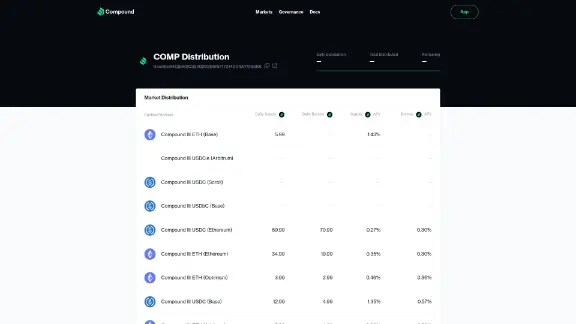
The COMP governance token was deployed on Ethereum in early 2020, and in June 2020 Compound began distributing COMP to users of the protocol, simultaneously transferring administrative control to token holders. COMP has a fixed maximum supply of 10 million tokens, a large portion of which was earmarked for gradual distribution to suppliers and borrowers.13 The tokens were distributed each Ethereum block and split between lenders and borrowers, initially on an even basis, so that active users of the protocol automatically accrued governance rights in proportion to their participation.8
The June 2020 distribution proved highly influential. By rewarding both sides of every market with a liquid, tradable token, Compound created a powerful incentive to supply and borrow assets, briefly making it the largest DeFi protocol by total value locked and touching off a wave of imitation across the industry. This period of rapidly expanding token-incentivized lending became known as "DeFi Summer," and liquidity mining or yield farming entered common use as terms for the practice Compound had popularized.18
Compound III ("Comet")
In August 2022, following a governance vote, Compound deployed Compound III, internally code-named "Comet," on the Ethereum mainnet. Compound III departed significantly from the pooled design of earlier versions. Rather than allowing an asset supplied as collateral to also be lent out, each Compound III market centers on a single borrowable "base asset" (such as USDC or ether), while other assets can be posted only as collateral and are held in isolation, not lent to other users.94 Its developers described the goals as improved security, greater capital efficiency, and a simpler, more predictable borrowing experience, with individual risk parameters set per collateral asset. The first market enabled borrowing of USDC against collateral including ETH, WBTC, LINK, UNI, and COMP.9 Compound III was subsequently deployed to additional networks, including Polygon, Arbitrum, and Base.5
Leadership change and Superstate
In 2023, co-founder Robert Leshner stepped down from leading Compound Labs to start a new company, Superstate, together with several other Compound Labs alumni. Superstate was formed to offer regulated, tokenized investment funds focused on short-term U.S. Treasury products, reflecting a broader industry move toward bringing traditional financial instruments on-chain.710 Day-to-day stewardship of the Compound protocol's growth and operations increasingly passed to DAO-funded service providers, including the firm AlphaGrowth, rather than to a single central company.11
Institutional reorientation and V2 deprecation
By the mid-2020s, Compound's governance turned toward consolidating activity on Compound III and courting institutional users. On-chain voting on an initial proposal to deprecate the aging Compound v2 markets began in October 2025, following analysis by the risk-modeling firm Gauntlet that cited declining usage and the systemic risks inherent in v2's older pooled-collateral model.5 The Compound DAO renewed its risk-management partnership with Gauntlet, tasked with monitoring and optimizing parameters across the protocol's growing set of Compound III deployments.5 In August 2026, the DAO approved a substantial operating budget, reported at roughly $52 million, to fund a strategic pivot toward institutional clients, the expansion of Compound III to additional blockchain networks, and the listing of new markets, including collateral assets such as liquid-staking tokens.56
Technology
Money markets and interest rates
Compound operates as a set of algorithmic money markets, one for each supported asset, into which users supply liquidity that other users can borrow. Interest rates are not set by any central authority, but are instead determined algorithmically as a function of each market's utilization rate, which is the proportion of supplied assets that is currently borrowed. As utilization rises, borrowing rates increase to encourage repayment and attract new deposits. As utilization falls, rates decline. Borrowers must maintain collateral worth more than the value of their loans, a design known as overcollateralization. Positions that fall below their required collateral ratio are subject to liquidation, in which a portion of the collateral is sold at a discount to third parties who repay the outstanding debt.12
cTokens
In Compound v2, supplying an asset returns a corresponding cToken, an ERC-20 token that represents the underlying deposit and accrues interest by increasing in redeemable value over time relative to the underlying asset. Because cTokens are standard, transferable tokens, they can be moved, traded, or used within other DeFi protocols while continuing to earn interest, a property that made them a widely used building block during the early growth of decentralized finance.24
Compound III architecture
Compound III replaced the fully pooled model of earlier versions with a market structure organized around a single borrowable base asset. In a given Compound III market, users borrow only the base asset, while collateral assets are held in isolation and are not lent out, reducing the protocol's exposure to the failure of any single collateral token. This design allows collateral-specific risk parameters, such as borrowing limits and liquidation thresholds, to be tuned individually, and its developers emphasized gains in security and capital efficiency relative to the pooled architecture of Compound v2.94
Governance
Compound is governed by holders of the COMP token through an on-chain system of proposals and voting. Token holders can vote directly or delegate their voting power to other addresses, and proposals that pass are queued in a time-locked contract before being executed automatically by the protocol's governance smart contracts.18 This structure, sometimes referred to by the name of its Governor contracts, became a widely copied template for on-chain DAO governance across the DeFi sector.
Compound's governance has also demonstrated the vulnerabilities of token-weighted voting. In 2024, a delegate group associated with a pseudonymous whale known as Humpy, nicknamed the Golden Boys, made repeated attempts to redirect COMP from the DAO treasury into a yield product under their influence. After earlier proposals numbered 247 and 279 were flagged as suspicious and rejected, Proposal 289 narrowly passed on 28 July 2024, authorizing the transfer of roughly 499,000 COMP, worth about $24 million at the time, into a strategy called goldCOMP. The passage, achieved after the group accumulated additional delegated voting power, was widely characterized as a governance attack and highlighted the risks of low voter participation in DAO systems.1213 Following community backlash and direct negotiation, the group agreed on 30 July to rescind the proposal in exchange for the development of an alternative COMP staking mechanism that would distribute a share of protocol reserves to token holders.1114
The 2021 COMP distribution bug
In late September 2021, a governance upgrade known as Proposal 62 introduced a mechanism to split COMP distribution between suppliers and borrowers according to governance-set ratios rather than the previous even split. The upgraded code contained a subtle error, a comparison operator written as > instead of >= in the distribution logic, which caused the protocol's Comptroller contract to pay out COMP incorrectly, in some cases allowing users to claim far more than they were owed.1516
The scale of funds at risk was significant. At worst, the flaw exposed on the order of 280,000 COMP, worth roughly $80 million at prevailing prices, to incorrect distribution, and a substantial quantity was claimed before the issue could be contained. The problem was compounded by a separate reservoir contract that continuously dripped additional COMP into the flawed Comptroller; when a user triggered the drip function, tens of millions of dollars in further COMP became exposed.1516 Because Compound's governance system requires a multi-day delay between a proposal's approval and its execution, the community could not immediately patch the contract. Fixes were enacted through subsequent governance proposals, and normal distribution was restored after a patch took effect in October 2021.1617 Leshner publicly appealed to recipients of the erroneous tokens to return them, drawing criticism after suggesting that unreturned funds could be reported as income to tax authorities.15
Market history
COMP has traded on cryptocurrency markets since its June 2020 launch, with its price broadly tracking the cycles of the wider DeFi sector. The token reached an all-time high in the range of roughly $850–910 in May 2021, during that year's cryptocurrency bull market and the peak of enthusiasm for DeFi lending, before entering a prolonged decline through the 2022–2023 bear market and trading well below its peak in subsequent years.1819 Analysts have frequently discussed COMP in the context of Compound's transition from an early market leader, briefly the largest DeFi protocol by total value locked in 2020, to one of several established lending protocols competing in a maturing sector, with the protocol's total value locked standing at roughly $1.54 billion in April 2026.56
Criticism and risks
Compound, like other DeFi lending protocols, is subject to a combination of smart-contract risk, market risk, and governance risk. The September 2021 distribution bug demonstrated how a minor coding error, combined with the deliberate delays built into decentralized governance, could put tens of millions of dollars at risk and leave developers temporarily unable to intervene.1516 The 2024 Golden Boys episode illustrated a distinct governance risk: because voting power is proportional to token holdings and voter turnout is often low, a sufficiently large and coordinated holder can push through proposals against the wishes of much of the community, raising broader questions about the security of token-weighted DAO governance.1213
More generally, overcollateralized lending protocols remain exposed to sharp market movements that can trigger cascading liquidations, to failures or manipulation of the price oracles they rely on, and to the risk that a collateral asset accepted by the protocol proves less sound than assumed. As Compound has moved to deprecate its older v2 markets and concentrate activity on Compound III while courting institutional users, commentators have noted that the protocol's future prospects depend heavily on successful multi-chain expansion, prudent risk management across a growing number of deployments, and its ability to compete with larger rivals in the DeFi lending market.56
References
- Messari. "What is Compound?" https://messari.io/project/compound/profile ↩ ↩ ↩ ↩ ↩ ↩
- Messari. "Compound Price, COMP to USD, Research, News & Fundraising." https://messari.io/project/compound ↩ ↩ ↩ ↩ ↩ ↩ ↩
- CoinMarketCap. "Robert Leshner - Co-founder Compound." https://coinmarketcap.com/academy/people/robert-leshner ↩ ↩ ↩ ↩
- docs.compound.finance. "Compound III Documentation." https://docs.compound.finance/ ↩ ↩ ↩ ↩ ↩
- CoinMarketCap. "Latest Compound News - (COMP) Future Outlook, Trends & Market Insights." https://coinmarketcap.com/cmc-ai/compound/latest-updates/ ↩ ↩ ↩ ↩ ↩ ↩ ↩
- CoinMarketCap. "Compound (COMP) Price Prediction For 2026 & Beyond." https://coinmarketcap.com/cmc-ai/compound/price-prediction/ ↩ ↩ ↩ ↩
- TRIZAN Founders. "Robert Leshner, DeFi / Blockchain at Compound Finance." https://trizan.com/founders/robert-leshner ↩ ↩ ↩
- IndexCoop / Lavi. "Introduction #1 Compound Finance." https://indexcoop.substack.com/p/introduction-1-compound-finance ↩ ↩ ↩
- Robert Leshner. "Compound III is Live." Compound Labs (Medium). https://medium.com/compound-finance/compound-iii-is-live-a7983dee7e60 ↩ ↩ ↩
- The Defiant. "Compound Token Surges After CEO Steps Down And Unveils New Venture." https://thedefiant.io/news/defi/compound-token-surges-after-ceo-steps-down-and-unveils-new-compliant-venture ↩
- Cointelegraph. "'Golden Boys' behind Compound 'governance attack' agree to rescind proposal." https://cointelegraph.com/news/golden-boys-behind-compound-governance-attack-agree-to-rescind-proposal ↩ ↩
- The Block. "$24 million Compound Finance proposal passed by whale over DAO objections." https://www.theblock.co/post/307943/24-million-compound-finance-proposal-passed-by-whale-over-dao-objections ↩ ↩
- The Defiant. "Compound Governance Attack Reveals Inherent Vulnerabilities Of DAOs." https://thedefiant.io/news/defi/compound-governance-attack-reveals-inherent-vulnerabilities-of-daos ↩ ↩
- Unchained. "Compound 'Governance Attackers' Agree to Cancel Proposal in Exchange for Staking Product." https://unchainedcrypto.com/compound-governance-attackers-agree-to-cancel-proposal-in-exchange-for-staking-product/ ↩
- CoinDesk. "DeFi Money Market Compound Overpays Millions in COMP Rewards in Possible Exploit; Founder Says $80M at Risk." https://www.coindesk.com/tech/2021/09/30/defi-money-market-compound-overpays-15m-in-comp-rewards-in-possible-exploit ↩ ↩ ↩ ↩
- The Block. "Compound bug leaves $80 million in COMP at risk of being misrewarded." https://www.theblock.co/news/defi/2021-09-29-compound-bug-comp-risk-misreward-119086 ↩ ↩ ↩ ↩
- BeInCrypto. "Compound Finance Passes Proposal to Fix COMP Distribution Bug." https://beincrypto.com/compound-finance-passes-proposal-to-fix-comp-distribution-bug/ ↩
- CoinGecko. "Compound Price: COMP/USD Live Price Chart, Market Cap & News Today." https://www.coingecko.com/en/coins/compound ↩
- Coinbase. "Compound (COMP) Price USD Today, News, Charts, Market Cap." https://www.coinbase.com/price/compound ↩