
Houdini Swap (LOCK)
Through an architecture blending liquidity aggregation, privacy layers, and flexible wallet options, Houdini Swap aims to serve as a central hub for sending, swapping, and bridging digital assets.
LOCK token
The platform native token, LOCK, functions as the utility token for Houdini Swap. It is deployed on both Ethereum and Solana, enabling cross-chain utility within the ecosystem. Although the article does not detail its exact use cases, LOCK may potentially be used for fee reductions, governance, or staking as part of the broader platform roadmap.
Overview and core offering
Houdini Swap supports over 4,000 tokens across multiple blockchains, acting as an aggregator for major cryptocurrency liquidity pools[1]. The platform distinguishes itself not only through the vast range of assets it supports, but also through its dual focus on user-centric design and privacy-first operations.
| Ticker | LOCK |
| Category | Privacy Coins |
| Website | https://houdiniswap.com/ |
| @HoudiniSwap | |
| Telegram | houdiniswap |
| Contract Addresses | |
|---|---|
| ethereum | 0x92...09 Copied! Copied! |
| solana | Ap...ihCopied! |
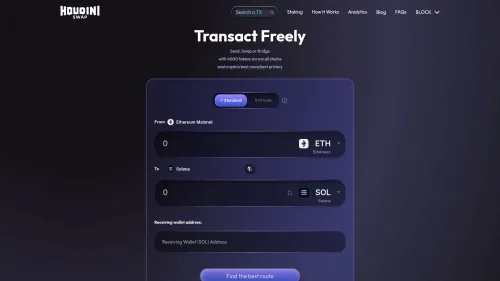
Users can choose between two main transaction methods, Wallet Connect and Manual Send, each tailored to different preferences regarding cost, privacy, and accessibility. Furthermore, Private Mode introduces a unique privacy-preserving mechanism that goes beyond the standard obfuscation tactics used by other crypto services[1].
Transaction methods
Wallet Connect
The Wallet Connect method utilizes browser-integrated wallets such as MetaMask, Rabby, or Trust Wallet. Transactions started this way execute entirely on-chain and are signed directly within the user wallet application. This approach prioritizes decentralization and user control, though it lacks inherent privacy due to the public nature of on-chain data. Wallet Connect transactions generally feature lower fees than alternative methods, making them a practical choice for users who are less concerned with transaction traceability.
Manual Send
Manual Send enables users to execute transactions without connecting a wallet directly to the platform. Once a transaction is created, a non-custodial exchange generates a unique deposit address. Users then transfer their tokens to this address manually to kick off the swap or bridge procedure.
This approach can provide enhanced privacy, especially for cross-chain transactions. While technically traceable, following a Manual Send transaction demands substantial resources and expertise. Manual Send is the sole available option for certain Private transactions and specific standard swap routes where connecting a wallet is not possible.
Private Mode: Anonymity Without Compromise
Houdini Swap's Private Mode is the platform's flagship privacy offering. It is built around a layered transaction architecture involving:
- Two non-custodial exchanges
- Single-use wallet addresses
- A randomized intermediary Layer 1 blockchain
This system ensures that no single entity, whether either of the two exchanges or any external observer, can reconstruct the complete path of a private transaction.
Dual Exchange Structure
During a private transaction, the process is split between two exchanges:
- Exchange 1 receives the user's funds and performs the initial swap.
- The funds are then routed through a randomly selected Layer 1 blockchain acting as a privacy intermediary.
- Exchange 2 receives the obfuscated funds on the other side, performs a final swap into the destination token, and sends them to the recipient.
Each exchange only sees its part of the process and has no knowledge of the full transaction route.
Role of the Layer 1 Privacy Intermediary
The randomized Layer 1 acts as a privacy layer between the two exchanges. Commonly used networks include TRX, LTC, SOL, and DOT, which are chosen for their deep liquidity and large transaction volumes.
Since the Layer 1 is randomly selected and undisclosed, and both exchanges use newly created single-use wallet addresses, reconstructing the transaction path becomes computationally and analytically infeasible.
Legacy Monero Routing
For users with specific privacy preferences, Houdini Swap retains support for its legacy v1 privacy layer, which utilizes Monero (XMR) exclusively. Users can toggle Monero support in settings, opting for a more traditional privacy coin route over the randomized Layer 1 method.
Data handling and compliance
Houdini Swap aims to balance transactional privacy with responsible data handling and compliance with applicable regulations.
Transaction data retention
- Private transaction data is stored for 72 hours to support customer service inquiries.
- After 72 hours, data is automatically deleted unless needed for compliance.
AML compliance
While Houdini Swap itself does not enforce Know Your Customer (KYC) procedures, its exchange partners implement risk-based monitoring and may request user information for flagged transactions. These cases are rare, and Houdini Swap's support team facilitates communication if needed.
Website data practices
- No use of tracking cookies for individual users
- Aggregated, anonymized data is retained for product development and marketing analytics
Accessibility and user choice
A major selling point for Houdini Swap is its flexibility. The platform allows users to operate with or without a connected wallet, depending on their privacy and transaction preferences. Wallet Connect is typically required when using decentralized exchange (DEX) routes, where unique deposit addresses are not generated.
Private Mode and Manual Send, however, allow users to conduct transactions without directly connecting a wallet, further enhancing privacy.