
NEAR Protocol (NEAR)
NEAR Protocol (native token: NEAR) is a public, layer-1 blockchain using a sharded proof-of-stake architecture called Nightshade, designed to support high-throughput, low-fee smart contracts and decentralized applications.12 Founded in 2018 by Illia Polosukhin and Alexander Skidanov, NEAR launched its mainnet in 2020 and has since repositioned itself, particularly from 2024 onward, as infrastructure specifically intended for AI agents, a pivot its founders describe not as a trend-chasing rebrand but as a return to the project's original 2017 starting point as an artificial-intelligence research effort.34
As of July 2026, NEAR traded at approximately $1.90 to $2.10, with a market capitalization of roughly $2.5 to 2.7 billion, placing it among the top 30 to 35 cryptocurrencies by that measure, though still more than 90% below its January 2022 all-time high.56
Overview
| Ticker | NEAR |
| Category | Artificial Intelligence (AI) |
| Website | https://near.org/ |
| @nearprotocol | |
| Telegram | cryptonear |
NEAR's core technical differentiator is Nightshade, a sharding design that splits network computation and state storage across multiple parallel shards while still producing a single, unified blockchain, allowing throughput to scale as network demand grows rather than requiring every validator to process every transaction.17 The network also builds account abstraction and human-readable account names directly into its base protocol, rather than adding them as an optional, wallet-level feature the way many other blockchains do.38 More recently, NEAR has built out "chain abstraction" tooling, including Chain Signatures, which let a NEAR account directly sign and control transactions on other blockchains such as Bitcoin and Ethereum, and NEAR Intents, which let users or automated agents specify a desired outcome and have competing "solvers" determine the most efficient way to execute it across any connected chain, positioning the network as infrastructure intended to sit invisibly underneath both human users and autonomous AI agents.39
This design philosophy, which NEAR's founders have described as treating blockchain as an "invisible layer" rather than something end users interact with directly, is intended to appeal both to mainstream consumers unfamiliar with cryptocurrency and to AI agents that the project's leadership expects will eventually transact autonomously and at far greater volume than human users.103
| Type | Layer-1 blockchain (sharded proof of stake) |
| Ticker | NEAR |
| Founders | Illia Polosukhin, Alexander Skidanov |
| Founded | 2017 (as NEAR.ai); 2018 (as NEAR Protocol) |
| Mainnet launch | April–October 2020 |
| Consensus mechanism | Thresholded Proof of Stake with Nightshade sharding |
| Initial supply | 1,000,000,000 NEAR |
| Annual inflation (2026) | 2.5% (reduced from 5% in October 2025) |
| Steward organization | NEAR Foundation (Switzerland) |
| Key technologies | Chain Signatures, NEAR Intents, Aurora, Rainbow Bridge |
History
Origins as an AI research project (2017–2018)
NEAR's founders both came from technical backgrounds outside blockchain. Illia Polosukhin spent roughly a decade as a machine-learning researcher, including several years at Google Research, where he contributed to the TensorFlow project and was one of eight co-authors of the 2017 paper "Attention Is All You Need," which introduced the Transformer architecture that underpins nearly all modern large language models, including GPT, Claude, and Gemini.411 Alexander Skidanov had previously worked as a software engineer at Microsoft before spending several years at the distributed-database company MemSQL (later SingleStore), where he worked on large-scale, distributed systems engineering.412 In 2017, the pair founded NEAR.ai, a startup aiming to build machine-learning tools capable of writing software code from natural-language descriptions.413 In the course of that work, they explored using blockchain and cryptographic incentive systems to coordinate globally distributed human contributors training their models, and concluded that no existing blockchain platform met their scalability and usability requirements, leading them to pivot toward building their own, which became NEAR Protocol.1314 Polosukhin has since described his upbringing in Ukraine amid periods of economic instability as an early influence on his interest in digital self-sovereignty and decentralized systems, themes he has continued to invoke in explaining NEAR's long-term mission.12
Founding, fundraising, and mainnet launch (2018–2021)
NEAR Protocol raised early funding from investors including Metastable Capital and Accomplice ($12.1 million) and, later, Andreessen Horowitz ($21.6 million), with the project ultimately raising approximately $1.1 billion across more than a dozen funding rounds over its history, according to Crunchbase data, with additional backers over time including Pantera Capital, Multicoin Capital, Dragonfly Capital, Coinbase Ventures, and Circle Ventures.1215 NEAR's BetaNet launched on April 22, 2020, with an initial token generation event distributing 1 billion NEAR tokens, followed by MainNet Phase 1 on October 13, 2020, operating with a limited, permissioned set of validators.1617 The network transitioned to full, community-operated MainNet Phase 2 on September 24, 2021, with a formal genesis block for the fully decentralized network created on November 23, 2021.16 By 2021, NEAR's ecosystem had grown to roughly one million accounts, and the project had built out core developer tooling and technical standards.4
Aurora, ecosystem growth, and early security incidents (2021–2023)
To connect NEAR with Ethereum's existing developer and liquidity base, the NEAR team built Aurora, an Ethereum Virtual Machine implementation running on NEAR's infrastructure, alongside the Rainbow Bridge, a trustless bridging protocol that uses cryptographic light-client proofs to move assets between Ethereum and NEAR without a centralized custodian.1819 NEAR's price rose substantially during the broader 2021 cryptocurrency bull market, reaching its all-time high of approximately $20.37 to $20.44 in January 2022.56 The network was not immune to the security incidents common across the broader decentralized finance industry during this period; in November 2022, Skyward Finance, a token-launch protocol built on NEAR, suffered an exploit resulting in a loss of approximately $3 million.20 In May 2023, a compromised moderator account on NEAR's official Discord server was used to promote a fraudulent token airdrop, which was a phishing-style incident common across many blockchain projects' community channels during this period.20
The chain-abstraction and AI pivot (2024)
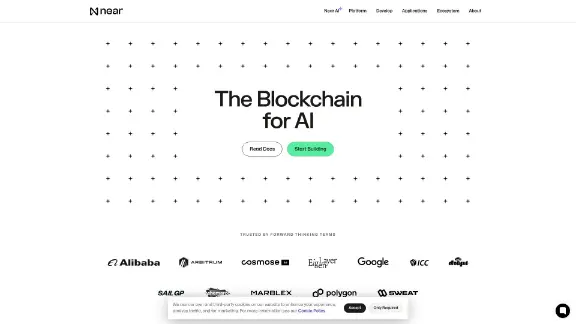
Beginning in 2024, NEAR undertook a significant strategic repositioning. Chain Signatures shipped to mainnet that year, allowing NEAR-based smart contracts, secured by multi-party computation, to sign and execute transactions on other blockchains without a conventional bridge.93 In May 2024, the NEAR Foundation formally announced its strategic focus on what it called user-owned AI, and in November 2024 launched NEAR AI, an open research initiative focused on building publicly auditable, privacy-preserving AI models and agent infrastructure, alongside the beta launch of NEAR Intents, built atop Chain Signatures, which allowed users and autonomous agents to express a desired outcome, such as a cross-chain swap, for competing solvers to fulfill.39 Polosukhin and the Foundation framed this blockchain for AI positioning not as a new direction, but as a return to the company's founding thesis, arguing that the large-language-model technology the founders had originally set out to build in 2017, and had found insufficiently mature at the time, had finally arrived with the rise of ChatGPT and similar systems.3
This period of strategic repositioning was accompanied by a widely criticized marketing episode. In September 2024, NEAR's official account on the social platform X abruptly changed its display name to it's all a lie and posted a series of messages resembling anti-crypto or account-compromise content, prompting widespread public speculation that the account had been hacked.20 NEAR subsequently indicated the episode was a deliberate marketing stunt tied to an upcoming announcement rather than a genuine security breach, a clarification that drew significant criticism from developers and industry commentators, who argued the stunt was tone-deaf given the frequency of genuine hacks and security incidents across the cryptocurrency industry; Bloomberg reported that NEAR's token price fell by roughly 15% over the following week amid the ensuing confusion and backlash.20
Continued rollout of chain abstraction and tokenomics changes (2025–2026)
Through 2025, NEAR Intents moved from beta into full production use, routing cross-chain swaps and other transactions through its solver network, and the company launched near.com, a unified account interface intended to let users hold, transfer, and confidentially trade assets across many different blockchains through a single NEAR account.910 NEAR also made two significant changes to its tokenomics during this period; on October 30, 2025, the network's maximum annual inflation rate was permanently halved from 5% to 2.5%, and on February 23, 2026, a fee-conversion mechanism activated for the first time, directing 100% of fees generated through NEAR Intents toward open-market purchases of NEAR tokens, a design explicitly compared by industry analysts to the effect of Ethereum's EIP-1559 fee-burning mechanism on ETH's own supply dynamics.21 Commentators modeling these changes estimated that, at prevailing 2026 fee rates, NEAR would become net deflationary once daily Intents transaction volume reached approximately $177 million, against a trailing 90-day average of roughly $77 million as of mid-2026.21 NEAR's price fell to a multi-year low of approximately $0.862 in February 2026 amid a broader altcoin market downturn, before partially recovering to the $1.90 to $2.90 range over the following months.226
Technical design
Nightshade sharding and consensus
NEAR's Nightshade architecture divides network state and transaction processing across multiple shards that are combined into a single logical blockchain, allowing the network's capacity to scale with the number of active shards rather than requiring every validator to process the network's full transaction load.17 Validators are selected through Thresholded Proof of Stake, in which a dynamic validator seat price is recalculated each epoch through an auction mechanism, with the total number of active validator seats and the amount of stake required to hold one adjusting based on overall network participation.2324 Reported network performance figures include block times of roughly 600 milliseconds, transaction finality of approximately 1.2 seconds following optimistic processing upgrades, average throughput in the tens of transactions per second with benchmarked bursts above 4,000 TPS, and typical transaction fees around $0.001.8
Chain Signatures and NEAR Intents
Chain Signatures use multi-party computation to allow a single NEAR account to generate valid signatures for transactions on other blockchains, including Bitcoin and Ethereum, without relying on a conventional, custodial, or lock-and-mint bridge design.93 NEAR Intents builds on this capability by letting users or software agents declare a desired final outcome, such as swapping asset A for asset B at the best available price across any connected chain, with a competitive marketplace of solvers bidding to execute that outcome most efficiently, abstracting away the need for the end user to manually select and interact with each underlying blockchain.93
Aurora and Rainbow Bridge
Aurora is a fully compatible Ethereum Virtual Machine built on top of NEAR's infrastructure, allowing existing Ethereum smart contracts and developer tooling to be deployed with minimal modification while benefiting from NEAR's lower fees and faster finality.1819 The Rainbow Bridge, a separate but complementary piece of infrastructure, uses cryptographic light-client proofs rather than a centralized custodian to move assets between Ethereum and NEAR/Aurora, and a portion of the NEAR fees Aurora's infrastructure collects over time is used to fund periodic, market-based buybacks and burns of Aurora's own separate governance token, AURORA.1925
Tokenomics
NEAR launched with an initial supply of 1 billion tokens at its 2020 token-generation event and does not have a fixed maximum supply; instead, new tokens are issued to validators and delegators through an annualized inflation rate that was reduced from 5% to 2.5% in October 2025.821 Of the gas fees generated by ordinary network transactions, 70% is permanently burned while the remaining 30% is credited to the smart contracts that generated the transaction, a design that can push the network's net token supply into deflationary territory during periods of high usage.2124 As of mid-2026, circulating supply stood at approximately 1.3 billion NEAR, with reported staking participation above 40% of total supply.824 Token allocations are also subject to an extended vesting schedule spanning categories including epoch (validator) rewards, early backers, community grants, core contributors, the original community token sale, and a foundation endowment, with unlocks continuing on an ongoing basis well beyond the network's initial launch.26
Ecosystem and organization
NEAR's core software is developed by NEAR Inc. (operating publicly as the "NEAR Collective," reported to employ more than 80 people), while the nonprofit NEAR Foundation, headquartered in Switzerland, oversees the protocol's broader development priorities, grants, and public communication, including its 2024 "Blockchain for AI" strategic announcement.38 NEAR AI operates as a related, publicly oriented research initiative focused on open-source, privacy-preserving AI model and agent development, an effort Polosukhin leads directly alongside his role as NEAR Foundation's chief executive.49 This dual role, leading both a major layer-one blockchain's foundation and its associated AI research arm, is itself an unusual structural feature among large cryptocurrency projects, most of which maintain a clearer separation between blockchain infrastructure development and any adjacent AI research efforts.4 Beyond Aurora, the broader NEAR ecosystem includes decentralized finance, NFT, and gaming applications, along with cross-chain interoperability tools including Wormhole-based messaging in addition to the Rainbow Bridge.8
Market history
NEAR's token has followed a pattern of substantial volatility broadly typical of layer-one "smart contract platform" tokens that rose to prominence during the 2021 bull market: after its 2020 launch, the token climbed to an all-time high near $20.37–$20.44 in January 2022, before falling sharply through the subsequent bear market and multiple further cycles.56 NEAR's all-time low of approximately $0.53 was set shortly after its launch, in November 2020; in February 2026 the token fell to a multi-year low of approximately $0.862, a decline some analysts linked to broader altcoin-market weakness rather than any NEAR-specific catalyst, before recovering into a roughly $1.90–$2.90 trading range over the following months.22627 As of July 2026, NEAR traded at approximately $1.90–$2.10, with a market capitalization in the $2.5–2.7 billion range, more than 90% below its 2022 peak.56
Positive developments and technical credibility
NEAR's AI-focused positioning carries a degree of technical credibility that is comparatively unusual within a cryptocurrency sector where "AI" branding has frequently been criticized as opportunistic marketing layered onto projects with little genuine connection to AI research. Polosukhin's direct authorship of the foundational Transformer paper, and Skidanov's deep background in large-scale distributed-systems engineering, give NEAR's AI-and-blockchain thesis a level of first-hand technical grounding that is uncommon among competing projects making similar claims.411 The network has also followed through on its chain-abstraction roadmap with functioning, mainnet-deployed technology, as Chain Signatures and NEAR Intents are live and processing real transaction volume rather than remaining purely theoretical roadmap items, and NEAR's October 2025 inflation reduction paired with its February 2026 fee-to-buyback mechanism represent genuine, structural tokenomics improvements rather than purely promotional announcements.921
The project's ability to raise approximately $1.1 billion across a wide range of well-known institutional investors, and to maintain continuous operation and active developer activity across more than five years since its mainnet launch, are further cited by supporters as evidence of durability relative to many shorter-lived layer-one competitors from the same era.1215 Supporters have also pointed to NEAR's willingness to make structurally significant, if commercially uncomfortable, tokenomics changes, such as cutting its own inflation rate in half and committing real fee revenue to open-market token purchases, as a sign of long-term discipline rather than short-term promotional messaging.21
Criticism and risks
NEAR's price has significantly underperformed its January 2022 peak for a prolonged period, a decline some analysts have attributed to intensifying competition among layer-one blockchains, broader cryptocurrency market cycles, and continued token dilution from the network's original 5% annual inflation rate prior to its October 2025 reduction.216 The September 2024 "it's all a lie" marketing stunt drew sustained criticism as an example of poor judgment by the project's communications team, with commentators arguing that simulating a hack for promotional purposes was particularly ill-considered given the prevalence of real security incidents, including NEAR's own 2022 Skyward Finance exploit and 2023 Discord compromise, across the broader industry.20
NEAR's multiple strategic repositionings over its history, moving from an AI research project, to a general-purpose "Ethereum alternative" smart-contract platform, to a "chain abstraction" specialist, to its current framing as infrastructure for AI agents, have also drawn skepticism from some observers, who have questioned whether each shift reflects a coherent, long-term technical vision or a series of opportunistic pivots toward whichever narrative was gaining the most attention in the broader cryptocurrency market at the time, while NEAR's defenders counter that the AI framing in particular predates the current AI hype cycle by years, given the founders' original 2017 starting point.34 Whether the broader market ultimately credits NEAR's AI-agent thesis as a durable competitive advantage, or views it as one more repositioning in a crowded field of layer-one blockchains all seeking differentiation, remained an open and actively debated question among cryptocurrency analysts as of mid-2026.621
References
- "Near price today, NEAR to USD live price, marketcap and chart." CoinDesk. https://www.coindesk.com/price/near-protocol ↩ ↩ ↩
- "NEAR (blockchain platform)." Wikipedia. https://en.wikipedia.org/wiki/NEAR_(blockchain_platform) ↩
- "Roadmap & History." NEAR Protocol. https://www.near.org/roadmap-history ↩ ↩ ↩ ↩ ↩ ↩ ↩ ↩ ↩ ↩ ↩
- "Who Is Illia Polosukhin? Transformer Co-Author & NEAR Founder." Phemex. https://phemex.com/academy/illia-polosukhin-near-cofounder-ai-agents ↩ ↩ ↩ ↩ ↩ ↩ ↩ ↩ ↩
- "NEAR Protocol price today, NEAR to USD live price, marketcap and chart." CoinMarketCap. https://coinmarketcap.com/currencies/near-protocol/ ↩ ↩ ↩ ↩
- "NEAR Protocol price today - NEAR price chart & live trends." Kraken. https://www.kraken.com/prices/near-protocol ↩ ↩ ↩ ↩ ↩ ↩ ↩ ↩
- "A Deepdive into NEAR - 2024." BestDapps. https://bestdapps.com/blogs/news/a-deepdive-into-near-2024 ↩ ↩
- "NEAR Protocol guide to sharding, tokenomics and ecosystem." Coinpaprika. https://coinpaprika.com/education/near-protocol-guide-to-sharding-tokenomics-and-ecosystem/ ↩ ↩ ↩ ↩ ↩ ↩
- "Near Protocol News Today: Ecosystem Update as of July 2026." CoinGabbar. https://www.coingabbar.com/en/crypto-currency-news/near-protocol-news-today-ecosystem-update-as-of-july-2026 ↩ ↩ ↩ ↩ ↩ ↩ ↩ ↩
- "The Sequence Chat #835: Illia Polosukhin on NEAR AI, Authoring the Transformer Paper and Decentralized and Private AI." The Sequence. https://thesequence.substack.com/p/the-sequence-chat-835-illia-polosukhin ↩ ↩
- "Ilya Polosukhin." NamuWiki. https://en.namu.wiki/w/%EC%9D%BC%EB%A6%AC%EC%95%BC%20%ED%8F%B4%EB%A1%9C%EC%88%98%ED%82%A8 ↩ ↩
- "NEAR Protocol Review 2024: Chain Abstraction, AI and More." Coin Bureau. https://coinbureau.com/review/near-protocol ↩ ↩ ↩ ↩
- "The History of NEAR Protocol and what problems does NEAR Protocol Solves." Medium, Near Crystal. https://medium.com/@crystal_n2r/the-history-of-near-protocol-and-what-problems-does-near-protocol-solves-802579a519e5 ↩ ↩
- "Near Protocol: Key Insights on This Crypto." Coinhouse. https://www.coinhouse.com/near-protocol ↩
- "NEAR Protocol Review 2024: Chain Abstraction, AI and More." Coin Bureau. https://coinbureau.com/review/near-protocol ↩ ↩
- "NEAR Protocol Price, Chart, Market Cap, NEAR Coin Essentials." CoinLore. https://www.coinlore.com/coin/near-protocol ↩ ↩
- "What is Near Protocol? (NEAR)." Kraken. https://www.kraken.com/learn/what-is-near-protocol ↩
- "What is Aurora (AURORA) Crypto? A Simple Guide to the NEAR-Ethereum Bridge." GlavX. https://glavx.org/what-is-aurora-aurora-crypto-a-simple-guide-to-the-near-ethereum-bridge ↩ ↩
- "Tokenomics." Aurora Documentation. https://doc.aurora.dev/getting-started/tokenomics/ ↩ ↩ ↩
- "NEAR (blockchain platform)." Wikipedia. https://en.wikipedia.org/wiki/NEAR_(blockchain_platform) ↩ ↩ ↩ ↩ ↩
- "NEAR Protocol 2026: Investment Case, Tokenomics & Deflation Threshold." SVRN. https://svrn.net/news/near-protocol-report ↩ ↩ ↩ ↩ ↩ ↩ ↩ ↩
- "NEAR Protocol Price, Chart, Market Cap, NEAR Coin Essentials." CoinLore. https://www.coinlore.com/coin/near-protocol ↩ ↩
- "NEAR." Blockdaemon Docs. https://docs.blockdaemon.com/docs/near-specific-info ↩
- "NEAR Protocol guide to sharding, tokenomics and ecosystem." Coinpaprika. https://coinpaprika.com/education/near-protocol-guide-to-sharding-tokenomics-and-ecosystem/ ↩ ↩ ↩
- "What Is Aurora (AURORA) And How Does It Work?" CoinMarketCap AI. https://coinmarketcap.com/cmc-ai/aurora-near/what-is/ ↩
- "NEAR Protocol (NEAR) | Token Burn Analytics & Supply Reduction." Tokenomist. https://tokenomist.ai/near/burn ↩
- "NEAR Protocol (NEAR) Price, Market Cap and Historical Data." CoinGecko. https://www.coingecko.com/en/coins/near ↩