
PAX Gold (PAXG)
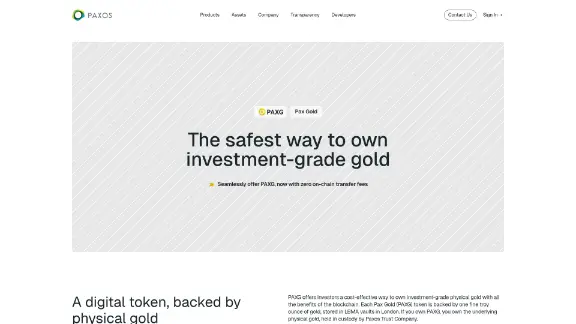
PAX Gold (ticker: PAXG) is a gold-backed digital asset issued by Paxos Trust Company in which each token represents ownership of one fine troy ounce of physical gold held in professional vault storage. Launched in September 2019, PAXG was created to make investment-grade gold more divisible, portable, and tradable by representing it as a token on a public blockchain rather than requiring investors to buy, store, and transport physical bars.12 Unlike U.S. dollar–pegged stablecoins, PAXG's value is not fixed but instead tracks the real-time market price of gold.2 As of July 2026, PAXG traded at roughly $4,100–$4,150 per token, with a circulating supply of approximately 449,000–452,000 tokens and a market capitalization of about $1.8 billion, having reached an all-time high near $5,620–$5,630 on January 29, 2026, amid a broader rally in gold prices.345
Overview
| Ticker | PAXG |
| Category | Stablecoins |
| Website | https://www.paxos.com/paxgold/ |
| @paxosglobal | |
| Contract Addresses | |
|---|---|
| ethereum | 0x45...78 Copied! Copied! |
Each PAXG token corresponds to a specific, serialized London Good Delivery gold bar — the standard recognized by the London Bullion Market Association (LBMA) — stored in Brink's vaults, and token holders can look up the serial number, weight, and vault location of the gold associated with their holdings using their wallet address.16 Paxos states that gold backing PAXG is held in a bankruptcy-remote structure, meaning it is legally segregated from Paxos's own corporate assets and would not be available to Paxos's creditors in the event the company became insolvent.67 Holders can redeem PAXG for physical gold bars, unallocated ("Loco London") gold in the case of institutional customers, or U.S. dollars at prevailing market prices, and Paxos charges no ongoing storage or custody fees, only modest, volume-tiered fees for creating and redeeming tokens.68
PAXG is built as an ERC-20 token on Ethereum and, since June 2026, is also available on the Solana blockchain, allowing holders to trade, transfer, and use the asset within either ecosystem's decentralized finance applications while Paxos continues to serve as the sole issuer and custodian of the underlying gold.9 Paxos publishes monthly independent attestation reports, verified by third-party accounting firms, confirming that the quantity of gold held in vaults matches the number of PAXG tokens in circulation.610
PAXG is often described by Paxos and industry commentators as occupying a middle ground between traditional gold investment vehicles and conventional cryptocurrencies. Compared with buying and storing physical bullion directly, PAXG removes the practical burdens of secure storage, insurance, transport, and verification of purity, while still preserving a direct legal claim on specific, identifiable gold bars rather than a purely synthetic or paper claim.18 Compared with gold exchange-traded funds (ETFs), which typically settle on a T+2 basis during conventional market hours and represent a claim against a fund structure rather than a specific bar, PAXG settles in near-real time on a blockchain and trades continuously, 24 hours a day, seven days a week, including during periods when traditional gold and equity markets are closed.6 Because PAXG is denominated and traded on public blockchains, it can also be used as programmable collateral within decentralized finance applications, a form of utility not available to holders of physical gold or most traditional gold-linked financial products.2
| Type | Gold-backed digital asset |
| Ticker | PAXG |
| Issuer | Paxos Trust Company, N.A. |
| Launched | September 2019 |
| Backing | 1:1 with London Good Delivery gold bars |
| Custodian | Brink's (vault storage) |
| Blockchains | Ethereum (ERC-20); Solana (since June 2026) |
| Regulator | Office of the Comptroller of the Currency (previously NYDFS) |
| Founder/CEO (Paxos) | Charles Cascarilla |
History
Paxos and the origins of PAXG (2012–2019)
Paxos Trust Company was founded in 2012 by Charles Cascarilla and Rich Teo, initially as itBit, a bitcoin exchange that became the first such exchange to be licensed by the New York State Department of Financial Services (NYDFS).11 In 2015, Paxos received one of the first limited-purpose trust charters granted by the NYDFS for a digital-asset company, establishing it as a regulated custodian and issuer years before most competitors in the space.12 Paxos launched its first U.S. dollar-backed stablecoin, Paxos Standard (later renamed Pax Dollar, or USDP), in September 2018.13
Cascarilla, who holds a finance degree from the University of Notre Dame and co-founded the investment firm Cedar Hill Capital Partners in 2005 before moving into digital assets, has served as Paxos's chief executive throughout the company's history and has publicly framed PAXG as a natural extension of Paxos's broader mission of bringing regulated, trust-based custody models to blockchain-based assets.1 The Paxos Trust Company structure — a New York-chartered trust rather than an ordinary corporation — was central to this positioning, since it meant that, from its earliest stablecoin and later commodity-tokenization efforts, customer assets held by Paxos were legally segregated from the company's own balance sheet under New York banking law, a structure the company has continued to emphasize as a differentiator from less formally regulated stablecoin and tokenization competitors.1112
PAX Gold followed roughly a year later, launching in September 2019 as Paxos's first tokenized commodity product.1 According to the project's whitepaper, PAXG was designed to address the fact that, while trillions of dollars' worth of gold exists for investment purposes globally, much of it remains inaccessible to smaller investors due to high minimum purchase sizes, storage costs, and the practical difficulty of transporting and verifying physical bars.1 By tokenizing fractional ownership of specific, audited gold bars, Paxos aimed to let investors buy amounts of gold as small as 0.001 troy ounce while retaining a direct legal claim on real, physical bullion rather than a synthetic or derivative exposure.8
Growth, BUSD wind-down, and regulatory developments (2019–2025)
Through the early 2020s, Paxos expanded its role as a regulated stablecoin infrastructure provider well beyond PAXG, most notably by issuing Binance USD (BUSD) on behalf of the cryptocurrency exchange Binance.13 In February 2023, the NYDFS ordered Paxos to stop minting new BUSD amid concerns related to the arrangement, after which BUSD entered a formal wind-down; existing BUSD holders retained the ability to redeem their tokens or convert them to USDP, but no new supply was created.1415 In August 2025, Paxos reached a $48.5 million settlement with the NYDFS related to compliance failures connected to its former BUSD partnership with Binance, including a $26.5 million civil penalty.15
Despite the BUSD episode, Paxos continued to expand its regulated product suite. In August 2023, the company became the issuer of record for PayPal USD (PYUSD), a dollar-backed stablecoin distributed through PayPal, which had grown to a supply of roughly $2.9–4.1 billion by early-to-mid 2026.1316 In November 2024, Paxos launched Global Dollar (USDG) through a consortium called the Global Dollar Network, aimed at non-U.S. distribution in partnership with firms including Robinhood and Anchorage.1317 Around 2025 and 2026, Paxos also pursued a shift from its original NYDFS trust charter toward supervision by the U.S. Office of the Comptroller of the Currency (OCC) at the national level, positioning the company, in its own description, for "GENIUS-ready" oversight of stablecoin issuance and custody under the federal GENIUS Act framework for stablecoins.12
Gold price rally and PAXG's all-time high (2025–2026)
PAXG's market value is directly tied to the spot price of gold, and the token's trading history closely mirrors gold's own price movements. Gold prices rose substantially through 2025 amid persistent inflation concerns, a weakening U.S. dollar, and geopolitical tensions, with reports describing PAXG rallying as much as 13.4% in a single month in early 2026 as investors sought safe-haven exposure.18 PAXG reached its all-time high of approximately $5,620–$5,630 on January 29, 2026, before subsequently retreating; by early July 2026, the token traded around $4,100–$4,150, roughly 26–27% below that peak, even as its market capitalization remained near $1.8 billion.4519
Multi-chain expansion and market position (2026)
In late June 2026, Paxos launched PAXG on the Solana blockchain through a decentralized finance protocol called Sunrise DeFi, extending the token beyond its original Ethereum deployment for the first time.9 Paxos described the move as offering faster transaction speeds and lower fees than Ethereum while preserving the same OCC-supervised regulatory oversight and gold backing.9 Around the same period, on-chain analytics firm Santiment reported that PAXG's daily active addresses reached a record of 8,830 on July 6, 2026, alongside a five-month peak in realized holder profits, which analysts attributed to renewed volatility in gold markets drawing capital onto blockchain rails.19 Separately, CoinGecko's 2026 real-world-asset report found that the tokenized commodities market grew by roughly 289% during the first quarter of 2026, with PAXG's share of that category reaching approximately 41.8%, and the data provider launched a dedicated tokenized real-world-asset tracker in July 2026 that included PAXG among its featured assets.9
Paxos has also positioned PAXG as a foundation for further product development within its "Paxos-Issued Assets" suite, which by 2026 also included the stablecoins USDP, PYUSD, and USDG, all governed under the same NYDFS-originated, and increasingly OCC-supervised, trust framework — a structure the company has argued gives institutional customers a single, consistent regulatory counterparty across both its fiat-backed and commodity-backed digital assets.1217
Technical design
Fee structure
Paxos charges a small, volume-tiered fee, generally cited at around 0.02%, for creating (minting) and redeeming (destroying) PAXG tokens through its own platform, but charges no recurring storage, custody, or vaulting fees for holding the token — a structural difference from most physical gold storage arrangements and some gold ETFs, which typically charge an ongoing annual expense ratio or storage fee regardless of trading activity.8 Holders who acquire or dispose of PAXG on secondary cryptocurrency exchanges instead pay that exchange's standard trading fees, and moving PAXG on the Ethereum network requires payment of standard Ethereum gas fees, separate from any Paxos-specific charges.8
Backing and redemption mechanism
Each PAXG token is backed one-to-one by a fine troy ounce of gold contained within a 400-ounce London Good Delivery bar, the LBMA-recognized standard for wholesale gold bars.68 When new gold is brought into Paxos's custody, a corresponding quantity of PAXG is minted; when tokens are redeemed, the corresponding gold is released and the tokens are destroyed (burned), keeping the circulating token supply in step with the quantity of gold actually held in trust.18 Paxos publishes serial numbers, weights, and vault locations for the underlying bars, allowing any holder to independently verify, via a lookup tool tied to their wallet address, exactly which physical bar (or fraction of a bar) their tokens represent.6
Smart contract and multi-chain architecture
PAXG's Ethereum smart contract has undergone independent security audits, including reviews published by CertiK and ChainSecurity, and the token is divisible to 18 decimal places, allowing for extremely small fractional gold holdings.720 Paxos monitors PAXG transactions using third-party blockchain-analytics tools as part of its anti-money-laundering and fraud-prevention program.20 The 2026 expansion to Solana via Sunrise DeFi represented Paxos's first extension of PAXG beyond Ethereum, and the company has indicated further multi-chain expansion may follow.9
Market history and competitors
PAXG's price has closely tracked the spot price of gold since launch, rising from roughly $1,388–$1,400 near its October 2019 debut to an all-time high near $5,620–$5,630 in January 2026, before retreating to the $4,100 range by mid-2026.45 PAXG's most significant direct competitor in the tokenized-gold category is Tether Gold (XAUT), issued by Tether, the company behind the USDT stablecoin; commentators have noted that market share between the two tokens tends to shift with broader regulatory sentiment toward each issuer, with PAXG's status as a product of a chartered, OCC- and (formerly) NYDFS-supervised trust company generally viewed as an advantage among institutional allocators that require formal regulatory compliance.19
The broader rally in gold prices that lifted PAXG to its January 2026 peak was widely attributed by market commentators to a combination of persistent global inflation concerns, sustained central bank gold purchases, a weakening U.S. dollar, and heightened geopolitical uncertainty — the same macroeconomic drivers typically cited for gold price movements generally, underscoring that PAXG's price behavior is, by design, a function of the physical gold market rather than of factors specific to the cryptocurrency industry.1819 This distinguishes PAXG's volatility profile from that of most cryptocurrencies, whose prices are driven primarily by crypto-specific supply, demand, and sentiment dynamics rather than by an independent, centuries-old commodity market.
Adoption and use cases
PAXG has found use both as a straightforward investment vehicle for gold exposure and as productive collateral within decentralized finance, where it can be deposited into lending protocols such as Aave to borrow against or to earn yield, a use case not available to holders of physical bullion or most gold exchange-traded funds.221 Because it trades continuously on cryptocurrency exchanges rather than being limited to the operating hours of traditional gold and futures markets, PAXG has also been marketed as a way to maintain continuous gold price exposure — including during periods when traditional gold trading is closed — and commentary during the 2025–2026 gold rally specifically noted increased use of PAXG as a 24/7 alternative to spot gold trading during market hours gaps.1922 Paxos has cited estimates from crypto analysts, including VanEck's Matthew Sigel, characterizing PAXG as a way to make a historically illiquid, bulky asset as tradable as any other blockchain-based token.22
Institutional interest in tokenized gold has grown alongside broader institutional adoption of tokenized real-world assets more generally, and PAXG has typically been cited by data providers as the largest or among the largest tokenized-gold products by market capitalization and trading volume, competing primarily with Tether Gold for that position.19 Paxos has marketed PAXG to both individual retail investors seeking a low-friction way to hold gold and institutional customers seeking programmatic, API-driven access to gold exposure and redemption, positioning the product as infrastructure that other exchanges, wallets, and lending platforms can integrate directly rather than as a retail-only offering.68
Regulation
PAXG is issued by Paxos Trust Company, which has operated under regulatory oversight from the NYDFS since 2015 and, more recently, has pursued supervision as a national trust company under the U.S. Office of the Comptroller of the Currency.1112 Paxos is also licensed as a Major Payment Institution by the Monetary Authority of Singapore, having been the first U.S.-based blockchain infrastructure platform to obtain that license, in 2022.12 In the European Union, PAXG has, as of mid-2026, remained outside the formal regulatory perimeter established by the Markets in Crypto-Assets (MiCA) framework, because no gold-backed tokens had yet been formally approved as asset-referenced tokens under that regime; Paxos has continued to rely on other licenses, including from Finland's Financial Supervisory Authority, to support its European operations in the interim.19
Risks and criticism
As with other custodial, asset-backed tokens, PAXG holders rely on Paxos's operational integrity, its vaulting partners, and its ongoing regulatory standing rather than holding the underlying gold directly in their own possession; commentators have noted that the durability of this trust-based model was tested by the 2023 BUSD wind-down and subsequent 2025 NYDFS settlement involving a different Paxos-issued token, episodes that Paxos and industry observers have characterized as evidence the company's segregated, bankruptcy-remote custody structure functioned as intended even under regulatory and counterparty stress.1519 Because PAXG's underlying gold is concentrated in Brink's-operated vaults in London, the token also carries a degree of geographic and custodial concentration risk not present in more geographically diversified physical gold holdings, although Paxos's monthly third-party attestations are intended to give holders ongoing assurance that reported reserves match circulating supply.610 More broadly, while PAXG is designed to track gold's price rather than exhibit the volatility typical of most cryptocurrencies, it remains subject to the operational risks common to blockchain-based assets generally, including smart-contract vulnerabilities (mitigated through the token's third-party security audits) and the liquidity conditions of the cryptocurrency exchanges on which it trades, which can occasionally cause its market price to deviate modestly from the spot price of gold.720
Critics of tokenized commodity products more generally have also noted that, while attestation reports provide periodic assurance of reserve backing, they are generally less rigorous than a full financial audit and rely on the continued cooperation and accuracy of both Paxos and its vaulting partners; Paxos has sought to address this concern by publishing serial-number-level lookup tools that allow individual holders, rather than only auditors, to independently verify the specific gold bars associated with the total supply of tokens outstanding.610
References
- "PAX Gold price today, PAXG to USD live price, marketcap and chart." CoinMarketCap. https://coinmarketcap.com/currencies/pax-gold/ ↩ ↩ ↩ ↩ ↩ ↩ ↩
- "PAXG Coin: The Paxos Gold-Backed Crypto Solution." Gemini. https://www.gemini.com/cryptopedia/what-is-pax-gold-paxg-token-paxos-gold-backed-crypto ↩ ↩ ↩ ↩
- "PAX Gold price today, PAXG to USD live price, marketcap and chart." CoinDesk. https://www.coindesk.com/price/pax-gold ↩
- "PAX Gold Price is $4,108.8 today." MetaMask. https://metamask.io/price/pax-gold ↩ ↩ ↩
- "PAXGUSD Charts and Quotes." TradingView. https://www.tradingview.com/symbols/PAXGUSD/ ↩ ↩ ↩
- "Paxos | Pax Gold (PAXG)." Paxos. https://www.paxos.com/pax-gold ↩ ↩ ↩ ↩ ↩ ↩ ↩ ↩ ↩ ↩
- "What Is PAXG? Everything You Need to Know." OSL. https://www.osl.com/hk-en/academy/article/what-is-paxg-everything-you-need-to-know ↩ ↩ ↩
- "What is Paxos Gold? (PAXG)." Kraken. https://www.kraken.com/learn/what-is-paxos-gold-paxg ↩ ↩ ↩ ↩ ↩ ↩ ↩ ↩
- "PAX Gold active addresses reach all-time high as profits hit 5-month peak." CryptoBriefing. https://cryptobriefing.com/pax-gold-active-addresses-all-time-high/ ↩ ↩ ↩ ↩ ↩
- "Blockchain | Pax Gold." Blockchain.com. https://www.blockchain.com/learning-portal/tokens/paxg-explained ↩ ↩ ↩
- "Paxos (company)." Wikipedia. https://en.wikipedia.org/wiki/Paxos_(company) ↩ ↩ ↩
- "Paxos | About Us." Paxos. https://www.paxos.com/company ↩ ↩ ↩ ↩ ↩ ↩
- "What Is USDP Stablecoin?" Eco Support. https://eco.com/support/en/articles/12257594-what-is-usdp-stablecoin ↩ ↩ ↩ ↩
- "Paxos | BUSD." Paxos. https://www.paxos.com/busd ↩
- "What is Paxos: The Complete Guide to Regulated Stablecoin Infrastructure." Eco Support. https://eco.com/support/en/articles/12257206-what-is-paxos-the-complete-guide-to-regulated-stablecoin-infrastructure ↩ ↩ ↩
- "Inside Paxos: USDP and PYUSD." Eco Support. https://eco.com/support/en/articles/14796321-inside-paxos-usdp-and-pyusd ↩
- "What is Paxos? Regulated Blockchain Infrastructure & Stablecoins Explained." Eco Support. https://eco.com/support/en/articles/12257206-what-is-paxos-regulated-blockchain-infrastructure-stablecoins-explained ↩ ↩
- "PAX Gold (PAXG): What Is It and How Does It Work?" Bitget. https://www.bitget.com/wiki/pax-gold-paxg-what-is-it ↩ ↩
- "PAX Gold active addresses reach all-time high as profits hit 5-month peak." CryptoBriefing. https://cryptobriefing.com/pax-gold-active-addresses-all-time-high/ ↩ ↩ ↩ ↩ ↩ ↩ ↩ ↩
- "PAXG Price Today, Charts & News 2026." KuCoin. https://www.kucoin.com/price/PAXG ↩ ↩ ↩
- "What Is PAXG? Everything You Need to Know." OSL. https://www.osl.com/hk-en/academy/article/what-is-paxg-everything-you-need-to-know ↩
- "Is PAXG Backed by Gold? Unpacking the Paxos Gold Token and Its Real-World Ties." WEEX Crypto Wiki. https://www.weex.com/wiki/article/is-paxg-backed-by-gold-unpacking-the-paxos-gold-token-and-its-real-world-ties-36080 ↩ ↩