
Zcash (ZEC)
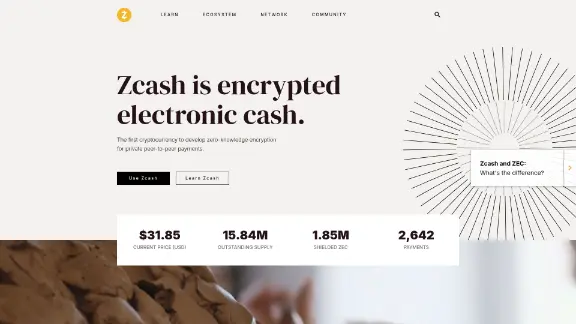
Zcash (currency symbol/ticker: ZEC) is a decentralized, open-source cryptocurrency that offers optional privacy for its users through zero-knowledge cryptographic proofs. Built on a codebase forked from Bitcoin, Zcash allows participants to choose between transparent transactions, which behave much like ordinary Bitcoin transactions and are fully visible on the public blockchain, and shielded transactions, which encrypt the sender, recipient, and amount involved while still allowing the network to verify that the transaction is valid. Zcash is often described as the most prominent example of a privacy coin, a category of cryptocurrencies designed primarily to obscure transaction details from public view.
| Ticker | ZEC |
| Category | Smart Contract Platform |
| Website | https://z.cash/ |
| @zcash | |
| Telegram | Zcash_Community |
| https://www.reddit.com/r/zec |
The Zcash protocol launched on October 28, 2016, and was initially developed by the Electric Coin Company, originally named the Zerocoin Electric Coin Company and commonly abbreviated ECC, a for-profit company founded by computer scientist Zooko Wilcox-O'Hearn. The project's cryptographic design descends from academic research into Zerocoin and Zerocash, zero-knowledge protocols developed by a group of cryptographers and computer scientists including Eli Ben-Sasson, Alessandro Chiesa, Christina Garman, Matthew Green, Ian Miers, Eran Tromer, and Madars Virza. Zcash has undergone a series of major protocol upgrades since launch, including Sapling, Blossom, Heartwood, Canopy, Network Upgrade 5 (NU5), Network Upgrade 6 (NU6), and Network Upgrade 6.1, which have progressively reduced the computational cost of shielded transactions, removed a controversial cryptographic trusted setup requirement, and altered the network's issuance and funding rules.
Overview
Like Bitcoin, Zcash has a fixed maximum supply of 21 million coins, and new coins are created through a proof-of-work mining process using variants of the Equihash hashing algorithm. Unlike Bitcoin, however, the Zcash protocol supports multiple types of addresses and transactions:
- Transparent addresses (t-addresses) function similarly to Bitcoin addresses; transaction amounts, senders, and recipients are all publicly visible on the blockchain.
- Shielded addresses (z-addresses) use zero-knowledge proofs, specifically a family of protocols known as zk-SNARKs (zero-knowledge succinct non-interactive arguments of knowledge), to encrypt transaction data while still allowing network validators to confirm that no coins are being counterfeited or double-spent.
- Unified addresses, introduced through Network Upgrade 5 and formally specified in ZIP 316, combine multiple receiver types into a single address string, letting wallets automatically select the most private or most compatible transfer method without requiring the user to manage several separate address formats.
Because shielding is optional rather than mandatory, Zcash is sometimes contrasted with Monero, another major privacy coin whose protocol enforces privacy on every transaction by default. Zcash's design philosophy has historically emphasized giving users a choice between privacy and transparency; for example, to accommodate businesses, auditors, or regulators who may need selective disclosure through the use of "viewing keys" that allow a shielded-transaction participant to reveal transaction details to a chosen third party without exposing them publicly.
History
Origins and academic foundations
Zcash's cryptographic foundations trace back to a 2013 paper on "Zerocoin," an extension proposed for Bitcoin that would have allowed coins to be anonymized through cryptographic proofs, authored by Ian Miers, Christina Garman, Matthew Green, and Aviel D. Rubin at Johns Hopkins University. This work was extended into "Zerocash," a more efficient successor protocol described in a 2014 paper by an expanded team of cryptographers, which proposed using zk-SNARKs to allow fully shielded transactions, hiding not just the origin of coins but also the amounts and destinations involved in every transaction.
In 2015, Zooko Wilcox-O'Hearn, a cryptographer previously involved in projects such as the peer-to-peer storage system Tahoe-LAFS and an early contributor to the DigiCash-adjacent cypherpunk scene, founded the Zerocoin Electric Coin Company to commercialize the Zerocash research and build it into a functioning cryptocurrency. The company later shortened its public-facing name to Electric Coin Company.
Launch and early development (2016)
Zcash launched its mainnet on October 28, 2016. Because generating the zk-SNARK proving and verification keys required a one-time trusted setup ceremony, which is a cryptographic procedure where secret parameters must be generated and then destroyed to guarantee the system's soundness, the ECC organized a multi-party ceremony widely referred to as "the Ceremony," in which several participants each generated and destroyed pieces of the secret data in different physical locations. The design was intended to ensure that as long as at least one participant honestly destroyed their portion of the secret information, the resulting system parameters could not be used to counterfeit coins undetected. A second, more decentralized ceremony with a larger number of participants, called "Powers of Tau" / Sapling MPC, was later conducted ahead of the Sapling upgrade.
At launch, through a mechanism sometimes referred to as the "Founders' Reward," 20% of the block reward for the first four years was allocated to the project's founders, investors, employees, and a strategic reserve, while the remaining 80% went to miners. This arrangement proved controversial within parts of the cryptocurrency community, who viewed it as a departure from Bitcoin's fully miner-funded issuance model, whereas supporters argued it was necessary to sustainably fund ongoing development of a technically complex protocol.
Network upgrades
Zcash's development has advanced through a series of coordinated network upgrades, each activating at a predetermined block height:
- Overwinter (2018) laid the technical groundwork, including replay protection and versioning improvements, for subsequent upgrades.
- Sapling (October 2018) dramatically reduced the computational resources required to construct shielded transactions, cutting proof-generation time and memory requirements enough to make shielded transactions practical on mobile devices for the first time, and introduced a new pool of shielded addresses (Sapling addresses, prefixed "zs").
- Blossom (2019) shortened block times from roughly 150 seconds to 75 seconds.
- Heartwood (2020) enabled Flyclient-style compact blockchain proofs and allowed miners to donate a portion of block subsidies to public goods funding via "founders reward" successor mechanisms.
- Canopy (November 2020) coincided with the expiration of the original Founders' Reward and replaced it with a new Zcash Development Fund, which redirected 20% of block rewards for a further four-year period, split among the Electric Coin Company, the Zcash Foundation, and a "Major Grants" fund intended to support outside developers and organizations.
- Network Upgrade 5 (NU5) (May 2022) was among the most significant upgrades in Zcash's history. It introduced the Orchard shielded pool, based on a new proving system called Halo 2. Unlike the original zk-SNARK construction used at launch (built on a scheme called Sprout, later superseded by the Sapling pool's Groth16-based proofs), Halo 2 does not require a trusted setup ceremony at all, eliminating one of the most persistent cryptographic and public-trust concerns associated with Zcash since its founding. NU5 also introduced unified addresses (ZIP 316) and Zcash Shielded Assets research groundwork.
- Network Upgrade 6 (NU6) (2024) restructured the block-reward split following the network's second halving, which occurred in November 2024 and reduced block-reward issuance. Under NU6, the development fund mechanism was replaced by a "lockbox" structure that accumulates a portion of block rewards in an in-protocol treasury pending future allocation decisions by the Zcash community.1
- Network Upgrade 6.1 (NU6.1) (2025–2026) further revised the funding model, allocating a defined share of block rewards to Zcash Community Grants and a separate share to a coinholder-directed lockbox mechanism, reflecting an ongoing shift toward more decentralized, on-chain governance of Zcash's development funding.1
Comparison with other privacy-focused cryptocurrencies
Zcash is frequently compared with Monero, the other major privacy-oriented cryptocurrency by market capitalization. The two projects differ substantially in design philosophy. Monero applies privacy, through ring signatures, stealth addresses, and confidential transaction amounts, to every transaction on its network by default, so that all Monero transactions are shielded from public view in a broadly uniform way. Zcash, by contrast, makes shielding optional, as users may choose transparent addresses that behave similarly to Bitcoin, shielded addresses that hide transaction details, or unified addresses that can encompass both. Proponents of Zcash's approach have argued that optionality allows the currency to more easily interoperate with exchanges, merchants, and regulatory frameworks that require at least some transparent activity, while critics have argued that optional privacy is weaker in practice than mandatory privacy, since a minority of shielded transactions on an otherwise mostly transparent network can, in some circumstances, be more susceptible to statistical or metadata-based analysis than transactions on a network where shielding is universal. Zcash is also frequently discussed alongside Bitcoin, given that its codebase originated as a fork of Bitcoin Core and it retains a similar fixed-supply, halving-based issuance schedule and proof-of-work consensus model, and commentary describing Zcash as offering an "encrypted" or privacy-enhanced alternative to Bitcoin has recurred periodically in industry press, particularly during periods when public discussion of on-chain surveillance or the long-term implications of quantum computing for transparent blockchains has intensified.
Notable events and milestones
Several events stand out in Zcash's development history. The original October 2016 trusted-setup ceremony was notable for its unusual security precautions, with participants in different geographic locations physically destroying hardware and key fragments after generating their portion of the shared secret parameters, in an effort to guarantee that no single party retained enough information to undermine the system's soundness. The Sapling upgrade's own trusted-setup ceremony, conducted with a much larger and more geographically and organizationally diverse set of participants than the original ceremony, was intended to further reduce the risk that any coordinated subset of participants could compromise the resulting parameters. The 2022 completion of Network Upgrade 5 and the associated deployment of the Halo 2 proving system was widely regarded within the Zcash community as resolving the trusted-setup concern permanently, since new shielded pools built on Halo 2 do not require any comparable ceremony. The November 2024 halving, which cut Zcash's block-reward issuance rate, was followed roughly a year later by a period of dramatic price appreciation that drew broader mainstream and institutional attention to the project, and by early 2026 Zcash's ranking among all cryptocurrencies by market capitalization had risen considerably higher than the project had occupied for much of its earlier history, according to industry trackers.23
Adoption and ecosystem
Beyond its role as a tradable asset, Zcash's ecosystem has developed a number of complementary projects and initiatives over time, including wallet software emphasizing shielded-by-default usage, infrastructure projects aimed at improving scalability, and institutional custody and auditing tools designed to make shielded ZEC holdings viable for regulated financial entities through the use of viewing keys. Independent organizations focused on Zcash-related investment, research, or infrastructure have periodically formed with outside venture funding, reflecting continued institutional interest in the project's underlying privacy technology even as the network's governance and funding structures have continued to evolve.2 Advocates have framed Zcash's use cases as extending beyond personal financial privacy to include protection of sensitive business information, such as trade secrets or supply-chain data, from competitors or third-party observers who might otherwise be able to analyze transaction flows on a fully transparent blockchain.
Governance changes and the 2026 Electric Coin Company transition
For most of its history, Zcash development was led jointly by two organizations: the Electric Coin Company, a for-profit entity founded by Wilcox-O'Hearn, and the Zcash Foundation, a separate non-profit organization established in 2017 to steward the protocol's open, public-good aspects and to reduce reliance on a single company. In early January 2026, the leadership of the Electric Coin Company announced that its entire development team was departing the organization, citing disputes over governance and changes to the terms of their engagement with bodies overseeing the Zcash Community Grants process.45 The departing team announced it would continue related privacy-technology development, including work on a Zashi-based wallet, under a newly formed company, while the Electric Coin Company and Zcash Foundation stated that the underlying Zcash protocol itself remained unaffected by the organizational changes, since Zcash's consensus rules are maintained by a broader, multi-implementation community rather than a single firm. The episode triggered a sharp, temporary decline in ZEC's market price amid investor uncertainty about the project's development continuity, though prices later partly recovered.4
Around the same period, the U.S. Securities and Exchange Commission closed a roughly two-year-long investigation into the Zcash Foundation, which had received a subpoena in 2023 as part of a broader inquiry into crypto-asset offerings, without recommending enforcement action, a development that market participants characterized as removing a significant regulatory overhang on the project.67
Technology
Zero-knowledge proofs and shielded transactions
The defining technical feature of Zcash is its use of zk-SNARKs to enable shielded transactions. In a shielded transaction, the sender constructs a cryptographic proof demonstrating that a transaction is valid, meaning that the funds being spent exist, have not already been spent, and that inputs equal outputs, without revealing the underlying values of the sender's address, the recipient's address, or the transaction amount to outside observers. Network validators, such as miners and full nodes, can verify this proof and add the transaction to the blockchain without ever learning the private details it conceals.
Zcash's shielded-pool cryptography has evolved through several generations:
- Sprout, the original shielded pool active at launch, relied on a zk-SNARK construction, based on the BCTV14/Pinocchio-style proving system, that required the original multi-party trusted-setup ceremony and was computationally demanding, often taking minutes and gigabytes of memory to generate a single proof.
- Sapling, introduced in 2018, replaced this with a Groth16-based proving system that reduced proof generation to a few seconds and made shielded transactions feasible on smartphones, while still requiring its own, larger, more participant-diverse trusted-setup ceremony.
- Orchard, introduced with NU5 in 2022, uses the Halo 2 proving system, which relies on a different mathematical approach, based on recursive proof composition without pairings, that eliminates the need for any trusted setup, closing a long-standing cryptographic and community-trust concern.
Viewing keys and selective disclosure
Zcash allows holders of shielded funds to generate viewing keys, which can be shared with a third party, such as an auditor, accountant, exchange, or regulator, to permit that party to see the details of specific shielded transactions without granting them the ability to spend the funds. This feature is intended to reconcile Zcash's privacy features with use cases requiring selective transparency, such as compliance, bookkeeping, or tax reporting.
Node software and client diversity
For most of its history, Zcash's reference node implementation was zcashd, maintained principally by the Electric Coin Company. Beginning in the early 2020s, the Zcash Foundation developed Zebra, an independent full-node implementation written in the Rust programming language, intended to reduce the network's reliance on a single software implementation and thereby improve resilience against implementation-specific bugs.2 By the mid-2020s, the Zcash community had begun formally deprecating zcashd in favor of Zebra as the primary consensus-layer client, alongside a broader set of complementary tools sometimes referred to as the "Z3 stack" (Zebra for consensus, together with wallet- and indexing-focused components).25
Wallets
Zcash-focused wallet software includes the Electric Coin Company's Zashi wallet, which is designed around shielded-by-default usage and unified addresses, along with various third-party and hardware-wallet integrations.1 Ongoing wallet-development priorities discussed by the Zcash community include features such as automatic shielding of incoming funds, transparent-address rotation to reduce address reuse, and improved recoverability and backup mechanisms.
Consensus mechanism
Zcash uses a proof-of-work consensus mechanism based on the Equihash algorithm, a memory-hard proof-of-work function originally designed to resist the efficiency advantages of specialized mining hardware (ASICs), though specialized Equihash mining hardware eventually emerged after launch. Miners compete to solve Equihash puzzles and are rewarded with newly minted ZEC plus transaction fees, subject to the block-reward split rules established by the network's active funding upgrade (see below). Zcash's issuance follows a halving schedule similar to Bitcoin's, with block rewards cut by half at fixed intervals; the first halving occurred in 2020 and the second in November 2024.
Economics and funding
Zcash's monetary policy fixes the total eventual supply at 21 million ZEC, mirroring Bitcoin's issuance cap. However, unlike Bitcoin, a substantial share of Zcash's block rewards has, at various points in the network's history, been redirected away from miners to fund ongoing protocol development, through mechanisms including the original Founders' Reward (2016–2020), the Zcash Development Fund established at the Canopy upgrade (2020–2024), and the lockbox and Community Grants mechanisms introduced under NU6 and NU6.1 following the 2024 halving. Supporters of these mechanisms argue that sustained, protocol-level funding is necessary to support the ongoing cryptographic research and software-engineering work required to maintain a technically sophisticated privacy protocol, while critics compare the arrangements unfavorably to Bitcoin's fully miner-funded model, sometimes characterizing them as a form of built-in "tax" on new issuance.
A distinguishing feature of Zcash's supply dynamics is the growing proportion of coins held in shielded pools rather than transparent addresses. Multiple industry analyses in 2025 and 2026 estimated that the share of circulating ZEC held in shielded form rose from roughly 8% in early 2024 to approximately 30% by mid-2026, a trend commentators link both to increased use of Zcash's privacy features and to reduced effective liquidity of the tradeable supply.87
Market history
Zcash traded as a highly volatile asset for most of its history. Following its November 2024 halving, ZEC entered a period of sharp price appreciation through late 2025, at one point reaching record highs above the $700 level and, according to multiple market trackers, briefly overtaking Monero to become the largest cryptocurrency by market capitalization within the "privacy coin" category.675 This rally was followed by a substantial correction and a period of consolidation in early-to-mid 2026. Commentators attributed the 2025 rally to a combination of factors, including reduced post-halving issuance, growing use of shielded addresses reducing liquid float, and renewed institutional and public commentary (including remarks from prominent figures in the broader Bitcoin and asset-management industry) framing privacy-preserving assets as a hedge against on-chain surveillance and potential future risks posed by quantum computing to transparent blockchains. Additional factors included corporate developments such as Grayscale Investments' 2025–2026 effort to convert its existing Zcash Trust into a U.S.-listed spot exchange-traded fund, which would represent the first regulated spot ETF built around a privacy-focused cryptocurrency.67
Criticism and regulatory scrutiny
Zcash's privacy features have drawn both praise and criticism. Privacy advocates and cryptographers praised the rigor of the project's academic and cryptographic foundations following its launch. Whistleblower Edward Snowden was in fact one of the participants in the original October 2016 trusted-setup ceremony, taking part under the pseudonym "John Dobbertin", with, by his own account, no stake in or payment from the project, a role that was not revealed publicly until 2022.910 At the same time, those same privacy features that distinguish Zcash from more transparent cryptocurrencies have led several cryptocurrency exchanges and jurisdictions to restrict or delist shielded-transaction support, citing anti-money-laundering and financial-surveillance requirements, and some exchanges have historically supported trading in ZEC only via transparent addresses. The project has also faced periodic regulatory scrutiny, including the multi-year SEC inquiry into the Zcash Foundation that concluded without enforcement action in January 2026. Market analysts continue to describe the unresolved regulatory treatment of privacy coins in various jurisdictions as an ongoing source of uncertainty for the asset's long-term adoption.
Governance
Zcash development and funding decisions have historically been distributed across several organizations and mechanisms, including the Electric Coin Company, the Zcash Foundation, and (following the NU6 and NU6.1 upgrades) an in-protocol Community Grants process intended to allow broader, more decentralized input from ZEC holders into how a portion of block-reward-derived funding is allocated. This governance structure has evolved substantially over time, notably following the January 2026 departure of the Electric Coin Company's development team, which prompted renewed public discussion within the Zcash community about the future distribution of development responsibility and funding oversight for the protocol.
References
- Crypto Adventure. "Zcash Review 2026: Shielded Payments, Unified Addresses, and Funding Changes." https://cryptoadventure.com/zcash-review-2026-shielded-payments-unified-addresses-and-funding-changes/ ↩ ↩ ↩
- CoinStats AI. "Zcash (ZEC) - Fundamental Analysis June 2026." https://coinstats.app/ai/a/fundamental-analysis-zcash ↩ ↩ ↩ ↩
- Phemex. "Zcash Price Prediction 2026–2030: Future Forecast & Analysis." https://phemex.com/blogs/zcash-zec-price-prediction-2026-2030 ↩
- deVere Group. "What is ZCash in 2026? (ZEC) – Update." https://www.devere-group.com/what-is-zcash-in-2026-zec/ ↩ ↩
- Theweal. "Breaking Crypto News: Zcash Updates and Future Outlook." https://theweal.com/2026/02/07/breaking-crypto-news-zcash-updates-and-future-outlook/amp/ ↩ ↩ ↩
- Bitcoin Foundation. "Zcash Price Prediction 2026: How High Can ZEC Go?" https://bitcoinfoundation.org/news/altcoins/zcash-price-prediction-2026-how-high-can-zec-go/ ↩ ↩ ↩
- Jagtap, Jahnu. "What Is Zcash? How the Leading Privacy Coin Works and Why It Matters in 2026." The Crypto Times. https://www.cryptotimes.io/learn/what-is-zcash/ ↩ ↩ ↩ ↩
- WEEX. "Why is Zcash (ZEC) so popular? | A 2026 Market Analysis." https://www.weex.com/questions/article/why-is-zcash-zec-so-popular-a-2026-market-analysis-66724 ↩
- Changelly. "Zcash (ZEC) Price Prediction 2026 2027 2028 - 2040." https://changelly.com/blog/zcash-zec-price-prediction/ ↩
- PR Newswire. "Edward Snowden Revealed as John Dobbertin, the Final Pseudonymous Member of 2016's Setup Process for Privacy-Preserving Cryptocurrency Zcash." https://www.prnewswire.com/news-releases/edward-snowden-revealed-as-john-dobbertin---the-final-pseudonymous-member-of-2016s-setup-process-for-privacy-preserving-cryptocurrency-zcash-confirmed-in-zcash-medias-latest-video-301534963.html ↩